AGI & Architectural Design.
A detailed thesis on intelligence, world models, embodiment, infrastructure, and the technological stack beyond the model.

The question we are asking too narrowly
The dominant conversation around artificial general intelligence is still largely framed as a race to build a better model.
More parameters. More data. More compute. Longer context. Better reasoning. More inference-time compute. Larger training runs.
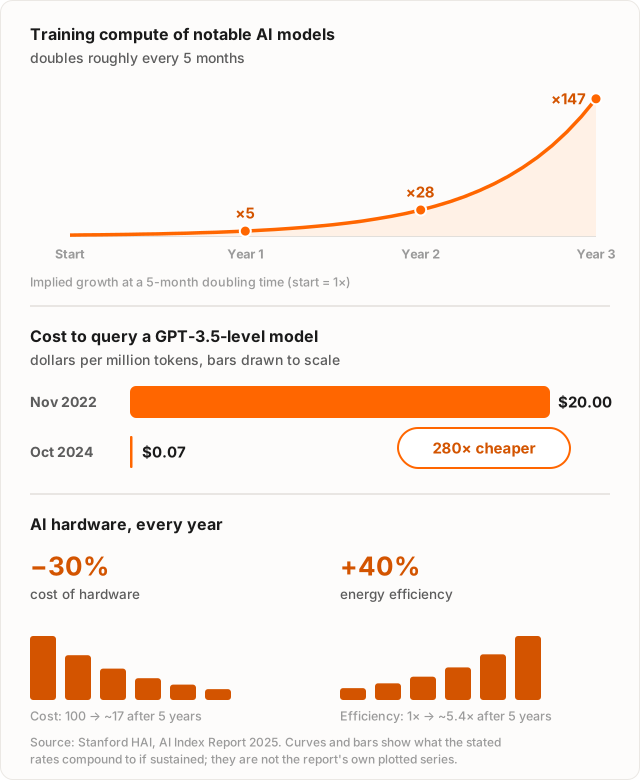
All of these things matter. The history of modern AI makes that difficult to deny. Scaling has produced extraordinary gains, and current research continues to push the frontier through larger training runs, better algorithms, improved hardware, and increasingly sophisticated inference. Stanford’s AI Index, for example, reports that the training compute used for notable AI models has continued to grow rapidly, while AI inference has simultaneously become dramatically cheaper.
But there is another question underneath the scaling question:
What if the next major step toward general intelligence is not simply a better model, but a better system?
That distinction matters.
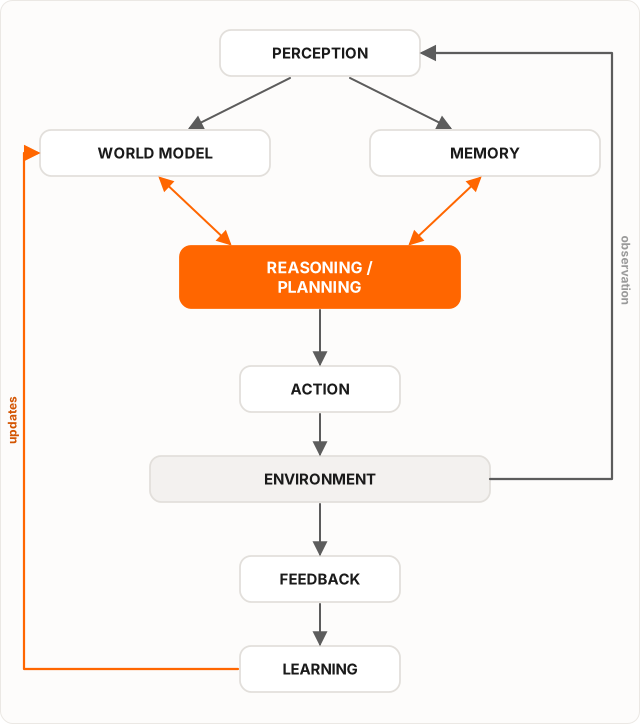
A model is a component. An intelligent system can be an architecture composed of many components: perception, memory, prediction, reasoning, planning, tools, action, feedback, learning, communication, and interaction with an environment.
Humans do not experience intelligence as a single prediction engine operating in isolation. We perceive a changing world. We remember previous states. We form internal representations. We predict what might happen next. We act. Reality pushes back. We update our understanding. We repeat the loop.
That suggests a different way to think about AGI.
Perhaps the central engineering problem is not simply:
“How do we make one model much bigger?”
Perhaps it is:
“How do we assemble the computational elements required for a system that can continuously perceive, model, reason about, act within, and learn from the world?”
That is the thesis of this essay.
I do not think scaling is irrelevant. I think scaling is one layer of the problem. The deeper question is architectural: how intelligence is organized, connected to memory and action, grounded in an environment, and ultimately embedded into the world.
And if that direction is correct, the most important technology of the next few decades may not be a single artificial mind.
It may be the architecture around intelligence.
01The long transition: from manual work to intelligent systems
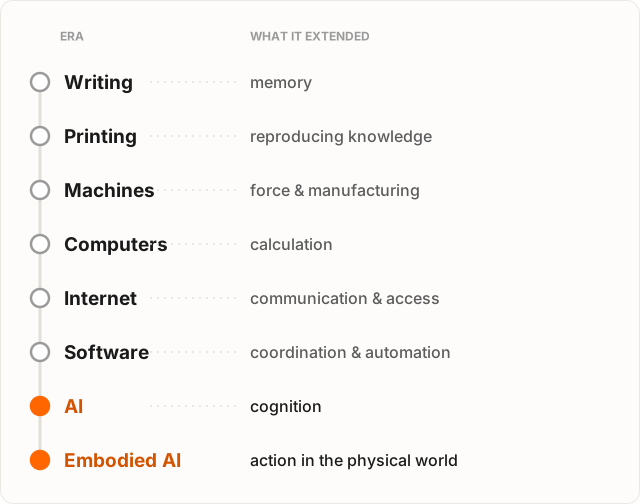
Human technological progress can be understood as a long sequence of tools that extend what humans can do.
The first machines extended physical force.
Writing extended memory.
Printing extended the ability to reproduce knowledge.
Industrial machinery extended manufacturing.
Computers extended calculation.
The internet extended communication and access to information.
Software extended the ability to coordinate and automate processes.
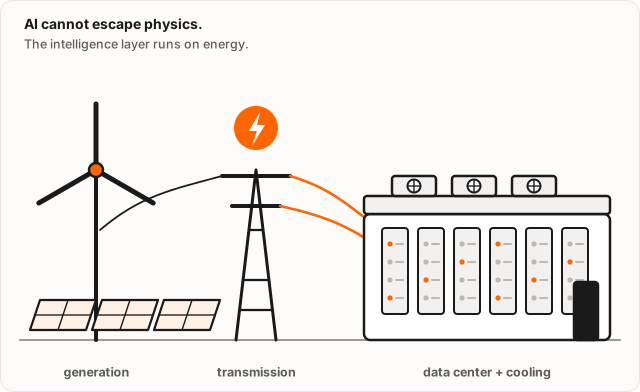
Artificial intelligence is extending something different: cognition.
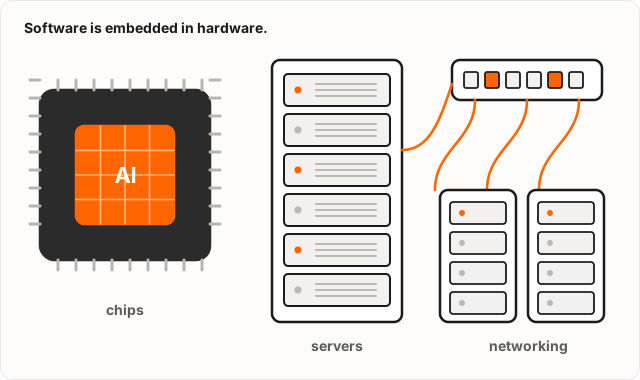
This progression matters because every technological layer changes what the layers above it can do.
The internet did not merely create another communication channel. It turned information into something that could be distributed almost instantly across a global network. Software did not merely replace paper. It transformed processes into programmable systems that could be copied, modified, automated, measured, and deployed at enormous scale.
AI now sits on top of that software and network layer.
That means intelligence itself is becoming programmable.
A person can ask a system to summarize a document, write software, analyze an image, translate a language, generate a design, reason through a problem, or operate a computer. The important transition is not that machines suddenly became conscious. They did not. The transition is that increasingly capable computational systems can perform portions of work that previously required human cognitive labor.
The historical pattern is therefore not simply “technology becomes more advanced.”
It is:
Human capability
→ externalized capability
→ programmable capability
→ networked capability
→ increasingly intelligent capability.
The next question is what happens when that intelligence is no longer confined to a chat window or software interface.
What happens when it can perceive an environment continuously?
What happens when it can maintain an internal model of that environment?
What happens when it can predict the consequences of actions before taking them?
What happens when it can use tools?
What happens when it can control machines?
What happens when it can learn from the consequences of its own actions?
And what happens when millions of such systems can operate simultaneously?
That is where the discussion moves from AI as software to AI as a general technological substrate.
02What do we actually mean by AGI?
Before arguing about how AGI should be built, we need to be careful about what AGI means.
There is no single universally accepted engineering definition.
In broad usage, artificial general intelligence refers to an artificial system with broad capabilities that can learn, reason, adapt, and perform a wide range of tasks rather than being narrowly optimized for one domain.
That definition leaves a great deal unresolved.
Does AGI require human-level performance across every cognitive domain?
Does it require continual learning?
Does it need autonomy?
Does it need a body?
Does it need consciousness?
Does it need to understand the physical world?
Does it need to reproduce the mechanisms of biological intelligence?
These questions are often mixed together.
They should be separated.
AGI does not necessarily mean “an artificial human brain.”
It may instead mean a sufficiently general architecture for learning and solving problems across environments.
This distinction changes the engineering target.
If the goal is to reproduce a human being computationally, neuroscience becomes the dominant reference point.
If the goal is to create a general-purpose intelligent system, biology becomes one source of architectural evidence rather than a specification that must be copied exactly.
The question becomes:
What properties of intelligent biological systems are computationally useful, and how can they be recreated with artificial components?
03The model is not the whole system
A modern AI model is extraordinarily powerful, but a model should not automatically be treated as the entire intelligent system.
Consider what a capable agent operating in the real world would require.
It would need to perceive.
It would need to identify relevant objects and events.
It would need to remember previous interactions.
It would need to maintain a representation of the current state of its environment.
It would need to predict possible future states.
It would need to reason about alternatives.
It would need to plan.
It would need to execute actions.
It would need to observe the consequences.
It would need to determine whether those consequences matched its expectations.
It would need to update its internal understanding.
It might need to communicate with humans and other agents.
It might need to use external tools.
It might need to know what it does not know.
None of these capabilities has to be implemented as one monolithic mechanism.
In fact, engineering often works by composing specialized components.
A car is not one giant mechanism. It is an architecture containing an engine, transmission, brakes, sensors, steering, electrical systems, control systems, and many other components.
A computer is not one algorithm. It is an architecture.
The internet is not one machine. It is an architecture.
A modern data center is not one computer. It is a system of systems.
There is no obvious reason artificial intelligence must remain a single model either.
The more useful question may be whether the components are assembled into a system that produces the properties we associate with general intelligence.
04Scaling is real, but it may not be the whole story
It would be a mistake to turn an architectural thesis into an anti-scaling thesis.
Scaling has clearly worked.
Modern AI has benefited enormously from larger datasets, more compute, better architectures, improved optimization, and increasingly capable hardware. Stanford’s 2025 AI Index reports that training compute for notable AI models has been doubling at roughly five-month intervals, while the cost of querying a model at a fixed performance threshold has fallen dramatically. The same report documents rapid improvements in hardware performance, price-performance, and energy efficiency.
The correct conclusion is not:
“Bigger models do not work.”
The stronger conclusion is:
“Bigger models may be one part of a larger architecture.”
A model can become better at representing patterns without necessarily solving every systems problem required for autonomous interaction with reality.
Consider memory.
A model may have a context window, but persistent memory introduces questions about what should be retained, how memories should be updated, how contradictions should be resolved, and how information should be retrieved.
Consider action.
A model can produce a plan, but executing that plan in the real world introduces latency, uncertainty, physical constraints, sensor noise, and irreversible consequences.
Consider learning.
A model trained once may be highly capable, but a continuously operating agent faces a changing environment. The system needs ways to incorporate new information without destroying useful existing knowledge.
Consider perception.
Text is a compressed representation of the world. Real environments contain spatial relationships, motion, texture, force, sound, depth, physical constraints, and events that may never be expressed linguistically.
Consider long-horizon planning.
An answer can be generated in seconds. A physical task may take hours, days, or weeks and require thousands of intermediate decisions.
These are architectural problems.
The next frontier may therefore be less about choosing between “scale” and “architecture” and more about discovering how scale and architecture interact.
05The brain as a clue, not a blueprint
The human brain is the most obvious example we have of a system capable of general intelligence.
But the useful question is not whether we can copy the brain neuron by neuron.
The useful question is:
What computational principles does the brain appear to exploit?
Humans do not perceive the world as a continuous stream of isolated pixels.
We construct representations.
We recognize objects even when sensory input changes.
We use memory to interpret current events.
We combine information from different senses.
We predict what is likely to happen.
We learn from interaction.
We use our bodies to explore the environment.
We can imagine hypothetical futures without physically experiencing them first.
And we can transfer knowledge from one situation to another.
These properties point toward a system in which perception, representation, prediction, action, and learning are tightly coupled.
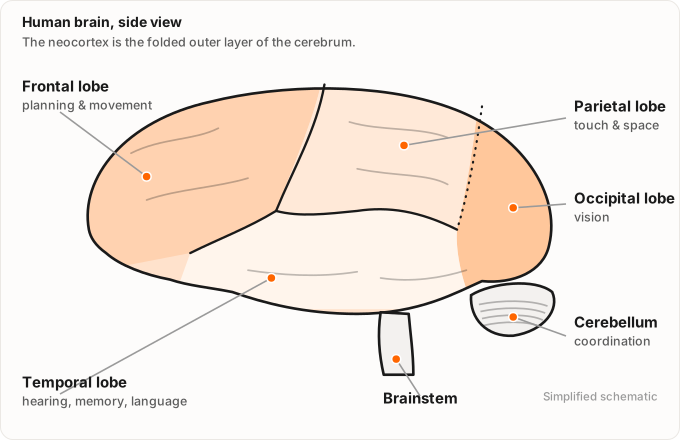
The neocortex is particularly interesting because it is involved in many forms of perception, representation, language, and complex cognition.
But it is important not to oversimplify neuroscience.
The neocortex is not the entire brain, and no single neuroscience theory has been established as a complete explanation of intelligence.
That distinction matters.
The brain should be treated as evidence that certain architectures can produce general intelligence, not as a finished engineering specification.
06The thousand brains theory
One of the most interesting architectural hypotheses in this area comes from Jeff Hawkins and researchers at Numenta.
The Thousand Brains Theory proposes that the neocortex contains many cortical columns capable of learning models of objects and the structure of the world.
Numenta describes the theory as a framework in which many models are built in parallel and combine their information to reach a consensus. A key component of the theory is the use of location-related representations and sensorimotor interaction.
A system does not only ask:
“What pattern am I seeing?”
It can also ask:
“Where am I relative to this thing?”
“What should I encounter if I move?”
“What features should exist at this location?”
“What happens if I interact with it?”
That is a profound shift.
It turns recognition into something connected to movement and prediction.
Imagine touching a coffee mug while blindfolded.
Your finger encounters one surface.
Move the finger.
Encounter another surface.
Move again.
You are not receiving one complete image of the mug.
You are constructing an internal representation through sequential interaction.
The Thousand Brains hypothesis argues that cortical columns may operate in a related way, building models through movement and integrating information across columns.
Whether every detail of this theory ultimately proves correct is a separate scientific question.
That caveat is important. The Thousand Brains Theory is a research hypothesis, not a settled description of the brain. Its value for this essay is that it presents a concrete architectural proposal: distributed models, sensorimotor learning, location-based representations, and integration across modalities.
That makes it unusually relevant to the question of machine intelligence.

07World models: an internal representation of reality
If an intelligent system is going to operate in the world, it needs more than the ability to respond to observations.
It needs some representation of how the world changes.
This is the idea behind world models.
A world model can be thought of as an internal predictive representation of an environment: what exists, how things relate to each other, and how the environment may change when actions are taken.
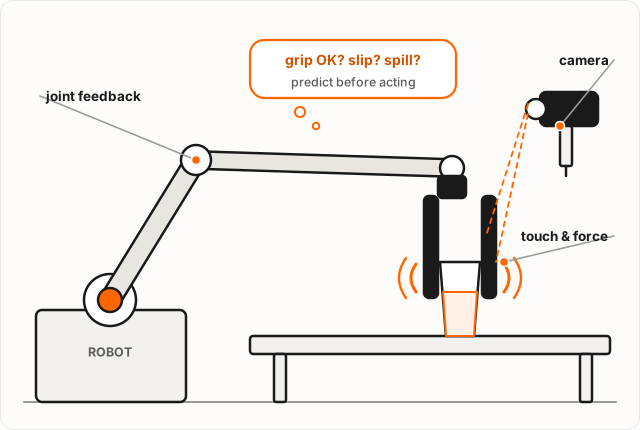
Suppose a robot sees a glass on a table.
Recognition is only the beginning.
A useful physical system might need to infer:
The glass is an object.
It has a location.
It has a shape.
It has a surface.
It may contain liquid.
It can be grasped.
If pushed, it may move.
If dropped, it may break.
If tilted, liquid may spill.
The robot therefore needs more than image classification.
It needs a model of consequences.
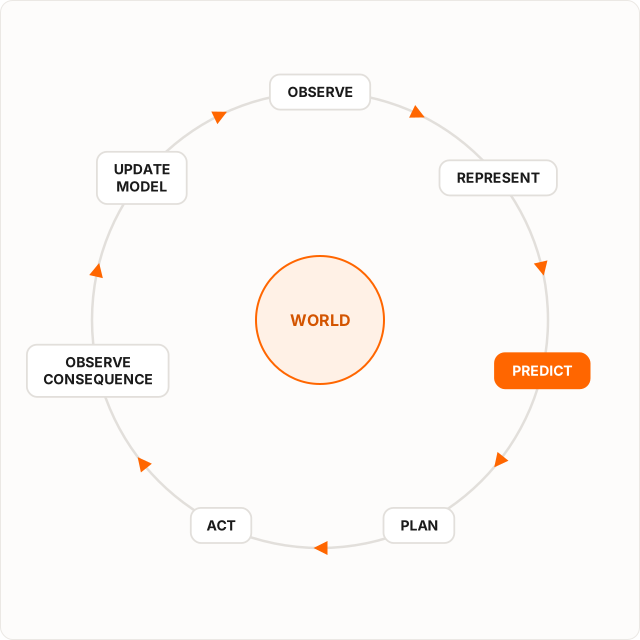
The important loop becomes:
OBSERVE
↓
REPRESENT
↓
PREDICT
↓
PLAN
↓
ACT
↓
OBSERVE CONSEQUENCE
↓
UPDATE MODEL
This is fundamentally different from treating intelligence as one-shot response generation.
Research on world models increasingly treats them as predictive representations that connect perception, simulation, planning, and control. Recent work in physical AI explicitly explores world models as a bridge between perception and action.
This does not mean today’s world models are complete models of reality.
They are not.
Long-horizon consistency, physical accuracy, uncertainty, data efficiency, and real-time control remain difficult research problems.
But the direction is important.
The system is moving from:
“What should I say?”
toward:
“What will happen if I do this?”
08From predicting language to predicting environments
There is an important bridge between language models and world models.
A language model predicts patterns in sequences of tokens.
A world model attempts to predict patterns in an environment.
The two are not identical.
Language describes the world, but language is not the world.
A sentence about gravity is not gravity.
A description of a robot arm is not the robot arm.
A recipe is not the physical act of cooking.
A programming instruction is not the machine executing the instruction.
Language gives an intelligent system access to an enormous amount of human knowledge. That is extremely valuable.
But interacting with reality introduces another layer of information.
The system learns not only from what people said happens, but from what actually happens when an action is performed.
That distinction is critical.
A robot can read ten million descriptions of how to pick up an object.
But physical interaction reveals things that descriptions may omit:
The object may be slippery.
The surface may be uneven.
The grip may be too weak.
The object may be heavier than expected.
The arm may collide with something.
The environment may change.
The action may produce an unexpected result.
Reality is an adversarial teacher.
It continuously tests the model.
09Embodiment: when intelligence gets a body
This leads to embodiment.
Embodied intelligence is intelligence operating through a physical or situated agent that must account for the consequences of its actions.
A body changes the problem.
A purely digital agent can make a mistake and generate another response.
A physical agent can break something.
A robot can fall.
A machine can collide with another machine.
A manipulation task can fail because a surface has unexpected friction.
A warehouse can contain a person who moves unpredictably.
A laboratory experiment can produce a result that the system did not anticipate.
Physical intelligence therefore requires closed-loop interaction with uncertainty.
But embodiment should not be treated as a binary requirement for AGI.
It is possible to argue that general intelligence can exist in purely digital environments.
A software agent can interact with operating systems, games, simulations, databases, networks, and other digital environments.
The stronger claim is this:
Physical embodiment may provide a fundamentally richer training and operating environment for systems intended to understand and manipulate the physical world.
And if the objective is to build machines that can contribute directly to physical production, eventually the intelligence must connect to physical action somehow.
10Simulation: a second world for machine intelligence
The physical world is an expensive classroom.
Every physical experiment costs time.
Hardware wears out.
Robots break.
People have to supervise systems.
Data collection is slow.
Rare events are difficult to capture.
Simulation changes this.
A simulated environment can allow an agent to practice thousands or millions of interactions without consuming equivalent physical resources.
This creates another architectural component:
the external world model.
The agent can learn inside simulation, then transfer useful behaviors into reality.
The relationship can become:
REAL WORLD
→ data
SIMULATION
→ massive experimentation
WORLD MODEL
→ prediction
AGENT
→ action
REAL WORLD
→ validation
The boundary between simulation and world models is increasingly interesting.
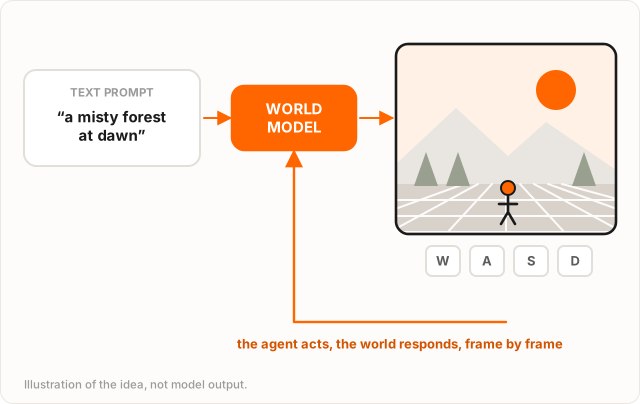
Google DeepMind’s Genie 3 is an example of the direction: DeepMind describes it as a general-purpose world model that can generate interactive environments from text and allow them to be explored in real time. DeepMind explicitly frames world models as systems that can help agents predict how environments evolve and how their actions affect those environments.
The important idea is not that a generated environment is a perfect copy of reality.
It isn’t.
The important idea is that intelligence may benefit from having environments in which it can practice, predict, experiment, and generate experience at scales that are difficult to obtain physically.
11Continual learning: intelligence that does not stop at deployment
Most deployed software is static.
A program is released.
A new version is shipped.
The user interacts with it.
The underlying code does not automatically reconstruct itself from every interaction.
An intelligent agent operating continuously in the world is different.
It encounters new situations.
It discovers mistakes.
It learns new relationships.
Its environment changes.
New objects appear.
New people interact with it.
Its own capabilities may change.
This creates a fundamental question:
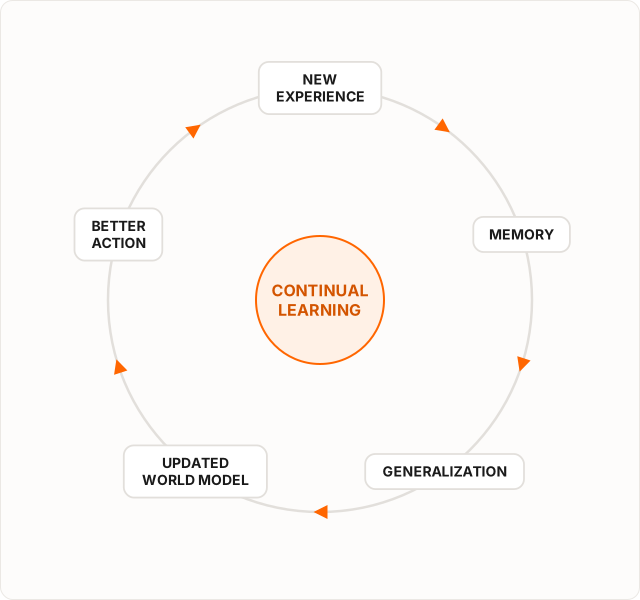
How does an intelligent system update itself without destroying what it already knows?
This is the continual learning problem.
Humans do this constantly.
We learn a new fact without forgetting the existence of gravity.
We encounter a new chair without rebuilding our entire concept of furniture.
We update our beliefs when evidence contradicts them.
A general artificial system would need some equivalent capability.
That might involve multiple layers:
- short-term working state
- persistent episodic memory
- semantic knowledge
- learned skills
- environment models
- task-specific adaptation
- long-term model updates.
The architecture matters because not every new observation should modify every layer.
A system needs mechanisms for deciding what should be remembered, what should be generalized, what should be discarded, and what should trigger deeper learning.
Numenta itself highlights continuous learning and learning through movement as principles it considers important for machine intelligence. Whether its broader cortical theory is correct remains open, but the systems problem is real regardless: an agent that lives in a changing world cannot rely entirely on a frozen snapshot of the world.
12Memory is more than context
A context window gives a model access to information currently placed into its input.
Memory is broader.
A persistent agent might need to remember:
- what happened yesterday
- what happened last week
- which tools worked
- which strategies failed
- what a particular environment looks like
- what a human prefers
- what a machine’s maintenance history contains
- what changed in the environment
- and what assumptions were previously proven wrong.
That creates another distinction:
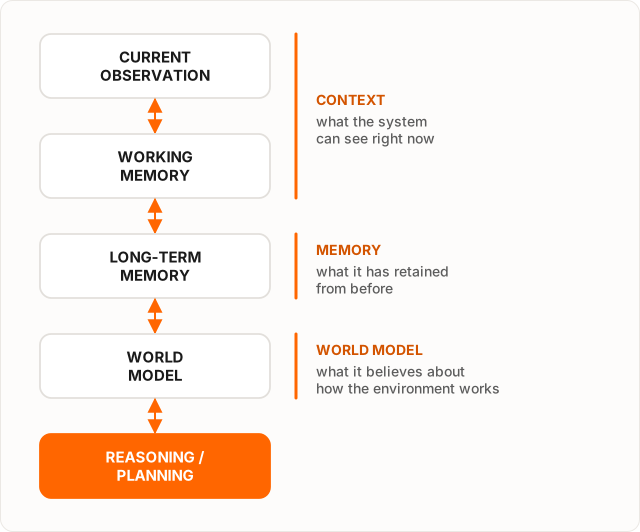
Context is what the system can see now.
Memory is what the system has retained from before.
World modeling is what the system believes about how the environment works.
These are related, but they are not the same thing.
A future intelligent architecture may therefore treat memory as a first-class system rather than merely giving a model a larger context window.
13Reasoning, planning, and action
Intelligence becomes much more powerful when it can evaluate possible futures.
Imagine a robot tasked with preparing a room.
It cannot simply react to the current frame.
It needs to construct a sequence:
identify objects
determine what needs to move
choose an order
predict whether movement is possible
execute
check the result
adapt
continue.
This is planning.
Planning introduces time.
The system is no longer answering:
“What is happening?”
It is asking:
“What should happen next?”
Then:
“What happens after that?”
Then:
“What happens if my assumption is wrong?”
This is where world models become particularly valuable.
A predictive model can allow an agent to simulate candidate actions before physically executing them.
If the model predicts that action A is likely to fail and action B is likely to succeed, the agent can prefer B.
In the real world it becomes extremely difficult because the model is imperfect.
Reality contains uncertainty.
The system therefore needs not only predictions but uncertainty estimates, fallback strategies, observation policies, and mechanisms for recovering from errors.
General intelligence may therefore require an architecture that can reason not only about the world, but about the reliability of its own predictions.
14The body becomes another computational layer
A body is not simply an output device.
The body itself provides information.
A robot arm can feel resistance.
A vehicle can detect acceleration.
A humanoid can sense balance.
A machine can detect temperature.
A gripper can measure force.
A robot can discover that an object is heavier than expected.
This means embodiment creates another feedback channel.
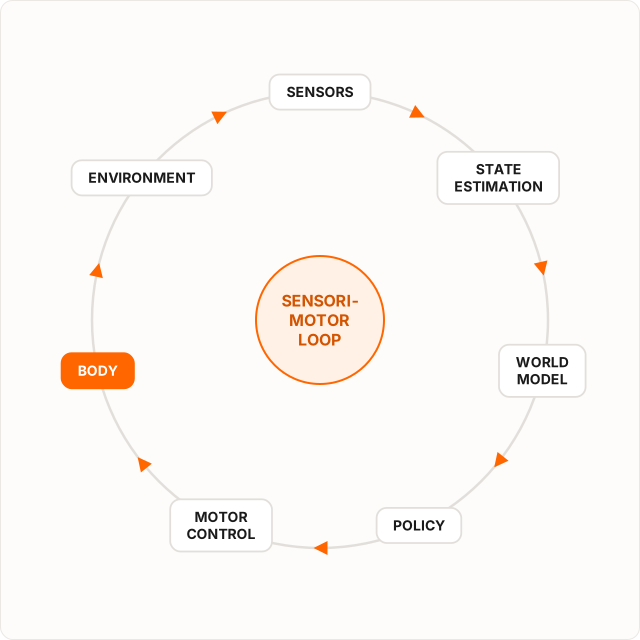
The system is not simply:
Brain → body.
It becomes:
Brain ↔ body ↔ environment.
This resembles a broader principle in biological intelligence.
Perception and action are not completely separate.
We learn by doing.
We understand objects by interacting with them.
We discover affordances by attempting actions.
The physical world is therefore not merely where intelligence is deployed.
It can also be where intelligence is learned.
15From digital intelligence to physical productivity
Now the thesis becomes economically interesting.
Software AI can amplify cognitive work.
Embodied AI can amplify physical work.
Put them together and something much larger becomes possible.
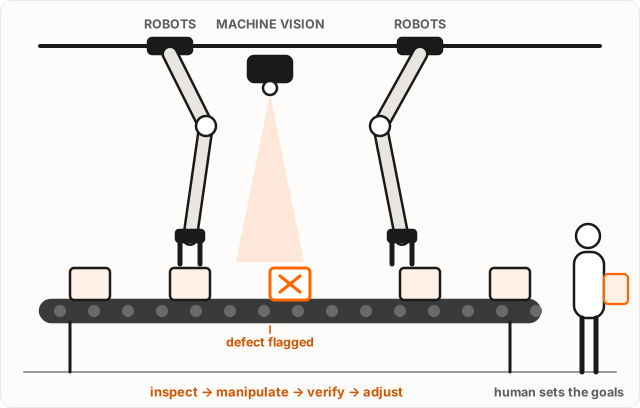
Imagine an AI system capable of:
designing a component,
simulating it,
ordering materials,
operating a manufacturing machine,
inspecting the result,
detecting defects,
redesigning the component,
and repeating the process.
That is not simply an AI assistant.
It is an intelligent production loop.
The same principle could apply to:
- manufacturing
- agriculture
- construction
- logistics
- scientific experimentation
- energy systems
- mining
- maintenance
- healthcare
- environmental monitoring
- and infrastructure development.
The important transition is:
AI that produces information
→
AI that produces decisions
→
AI that produces actions
→
AI that participates directly in production.
That is where the idea of abundance becomes more concrete.
Not because intelligence magically creates resources.
Because intelligence can potentially make the systems that transform resources into useful things more productive.
16Abundance is not an automatic consequence of AGI
This distinction is critical.
AGI does not automatically create abundance.
A highly intelligent system still needs:
- energy
- compute
- semiconductors
- raw materials
- factories
- robots
- transportation
- capital
- software
- networks
- legal systems
- maintenance
- human coordination
- distribution.
Intelligence can improve the efficiency of these systems, but it does not eliminate them.
This is why infrastructure matters so much.
A breakthrough model sitting in a research lab does not automatically become a million deployed machines.
Someone has to manufacture the hardware.
Someone has to provide energy.
Someone has to connect the system.
Someone has to finance deployment.
Someone has to maintain it.
Someone has to build the software that allows the system to interact with existing infrastructure.
Someone has to make the technology accessible.
This leads to a principle that deserves more attention:
Intelligence is productive capacity only when it is connected to infrastructure.
17The infrastructure stack of an intelligent world
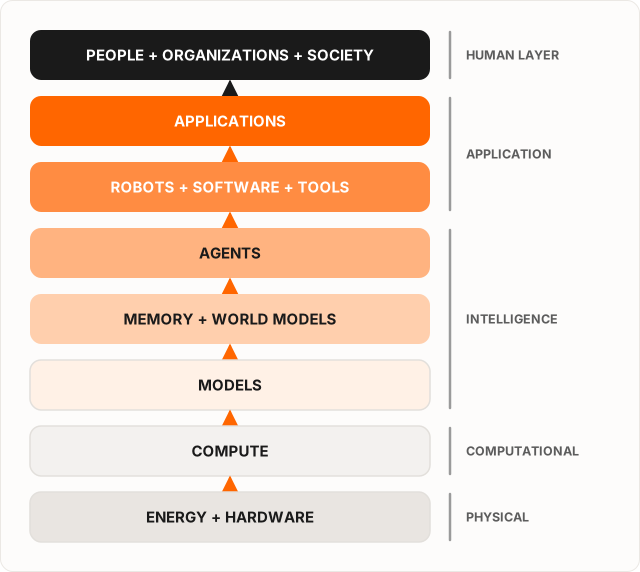
If the future is built around intelligent machines, the technology stack becomes much larger than AI models.
At the bottom is physical infrastructure.
Energy.
Data centers.
Semiconductors.
Networking.
Robotic hardware.
Factories.
Sensors.
Transportation.
Above that sits computational infrastructure.
Training systems.
Inference systems.
Distributed computing.
Storage.
Model serving.
Evaluation.
Security.
Above that sits intelligence infrastructure.
Foundation models.
World models.
Memory systems.
Planning systems.
Agent frameworks.
Tool-use systems.
Simulation.
Above that sits application infrastructure.
Software agents.
Robotic operating systems.
Industrial automation.
Scientific systems.
Financial systems.
Healthcare systems.
Education systems.
Consumer products.
And above all of it is the human layer:
people,
organizations,
markets,
institutions,
and society.
This means the future of AGI is also a systems-engineering problem.
The model is only one layer.
18The bottleneck question
There is a useful way to approach the future:
Ask what prevents humanity from producing more.
Sometimes the bottleneck is information.
Sometimes it is labor.
Sometimes it is energy.
Sometimes it is capital.
Sometimes it is manufacturing.
Sometimes it is coordination.
Sometimes it is scientific understanding.
AI attacks one particularly important bottleneck:
cognitive labor.
Robotics attacks another:
physical labor.
Automation connects them.
Infrastructure makes them deployable.
Finance makes deployment possible.
Networks make them accessible.
That produces a possible chain:
INTELLIGENCE
→
AUTOMATION
→
PRODUCTIVE CAPACITY
→
LOWER COSTS
→
GREATER OUTPUT
→
GREATER ACCESS.
But each arrow is an engineering and economic problem.
That is why the future cannot be reduced to “build AGI.”
The actual challenge is:
Build intelligence.
Connect it to action.
Build the infrastructure that supports it.
Deploy it.
Make it reliable.
Make it affordable.
Make its benefits accessible.
Then allow the resulting productivity to compound.
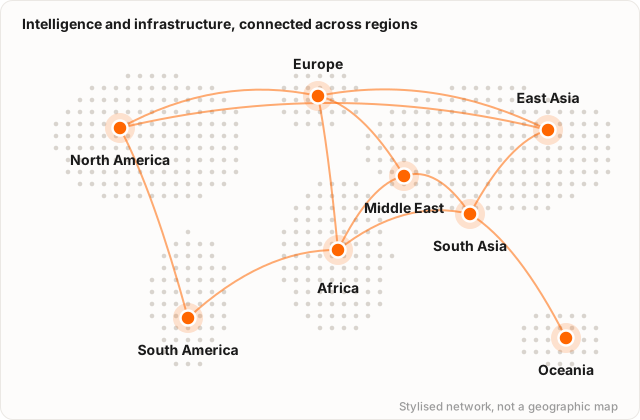
19Global accessibility may matter as much as raw capability
There is another problem that receives less attention in technical AGI discussions.
Who gets access?
If increasingly capable intelligence is concentrated in a small number of institutions, the technological potential of the system may not translate into broad human capability.
The internet provides an instructive comparison.
Its significance was not only that computers could communicate.
Its significance was that communication and information became globally accessible through infrastructure.
AI can follow a similar pattern.
A highly capable model is valuable.
A highly capable model that millions of people can access through affordable tools is transformative in a different way.
The same is true for robotics and physical infrastructure.
A robot that can perform a task in one laboratory is a technical achievement.
A production system that can deploy the same capability across thousands of facilities is infrastructure.
The difference between invention and civilization-scale impact is often distribution.
20The role of AI software and agents
This is where AI software infrastructure becomes particularly important.
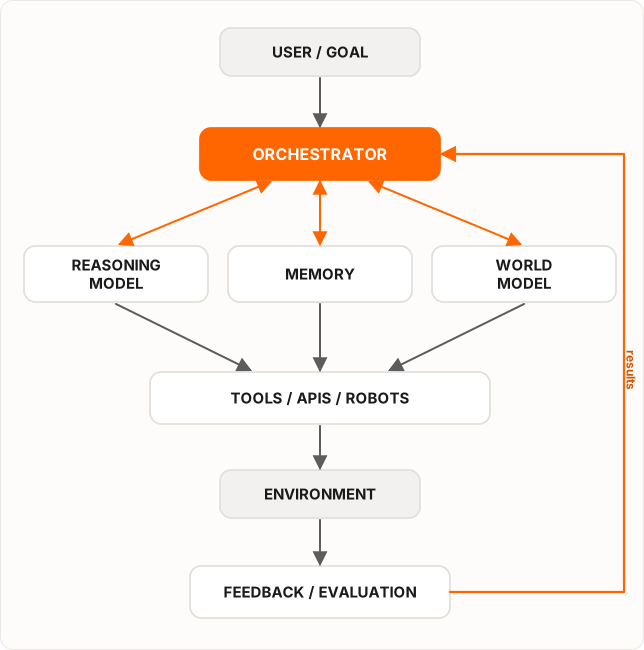
Agents can serve as the connective tissue between models and existing systems.
A model can reason.
An agent can give that reasoning access to:
- software
- databases
- APIs
- files
- browsers
- financial systems
- communication systems
- robotic controls
- sensors
- and other models.
This changes the architecture from:
MODEL → OUTPUT
to:
MODEL → TOOL → ENVIRONMENT → RESULT → MODEL.
That loop is much closer to an operating system for intelligence.
An agent can coordinate specialized models.
One system can handle vision.
Another can handle speech.
Another can handle planning.
Another can control a robot.
Another can evaluate safety.
Another can retrieve information.
The architecture becomes compositional.
Instead of expecting one model to do everything, we can construct systems in which intelligence is distributed across specialized components.
21Specialization does not necessarily mean fragmentation
A common assumption is that general intelligence requires one system capable of everything.
It may not.
Human society itself is extremely specialized.
A person does not need to personally know how to manufacture a semiconductor.
They rely on other people and institutions.
Civilization is a distributed intelligence system.
One person contributes engineering.
Another contributes medicine.
Another contributes agriculture.
Another contributes logistics.
Another contributes finance.
Another contributes manufacturing.
Networks connect these capabilities.
AI systems could operate similarly.
A general intelligent architecture could coordinate specialized components rather than internally reproducing every capability in one monolithic model.
This may be one of the deepest architectural possibilities:
AGI may not be a single artificial mind.
It may be an intelligent system of systems.
22Multi-agent and collective intelligence
Once multiple intelligent systems can communicate, another layer appears.
Coordination.
Imagine a group of agents where:
- one observes
- one plans
- one executes
- one verifies
- one monitors safety
- one manages resources
- and one communicates with humans.
The collective can potentially perform tasks that are difficult for any single component.
Again, this does not mean multi-agent systems automatically produce AGI.
Coordination itself creates difficult problems:
communication overhead,
conflicting objectives,
error propagation,
trust,
verification,
resource allocation,
and control.
But it reinforces the architectural thesis.
Intelligence can be compositional.
23Safety is also an architectural problem
If intelligent systems become increasingly autonomous, safety cannot be treated as a final filter placed on top.
It has to exist throughout the architecture.
A physical agent needs:
- permission boundaries
- action constraints
- monitoring
- uncertainty estimation
- human override
- verification
- safe fallback behaviors
- and clear interfaces between planning and execution.
A system that can reason about an action should not automatically have unrestricted permission to execute it.
This introduces another useful separation:
Intelligence is the ability to reason.
Authority is the permission to act.
Capability is the ability to execute.
These should not necessarily be identical.
A highly intelligent system can be useful precisely because its intelligence is connected to carefully scoped authority.
The architecture therefore has to encode not only what the system can do, but what it is allowed to do.
24The hardest problem may be reliability
A system can be intelligent and still be unreliable.
A language model can produce a brilliant answer and then confidently make an error.
A robot can perform a task successfully ninety-nine times and fail on the hundredth.
A world model can predict most environments correctly and fail on an edge case.
In physical systems, small errors can become large consequences.
This means AGI cannot be evaluated only by benchmark scores.
We will need to evaluate:
generalization,
robustness,
long-horizon performance,
adaptability,
uncertainty calibration,
physical safety,
recovery from errors,
ability to learn from failures,
and performance under distribution shift.
The intelligent machine of the future should not merely succeed.
It should know when it is likely to fail.
25What would actually make this thesis wrong?
A serious thesis needs a way to be challenged.
There are several ways this architectural thesis could be wrong.
First, continued scaling could produce increasingly general capabilities inside a relatively simple model architecture.
Second, purely digital intelligence could become broadly general without needing physical embodiment.
Third, external memory and tools might solve many of the problems that appear to require specialized cognitive architectures.
Fourth, world models might turn out to be less important than expected.
Fifth, robotics might remain too economically and technically difficult for physical AI to become a dominant pathway.
Sixth, the limiting factor may not be intelligence at all.
It could be energy.
It could be manufacturing.
It could be data.
It could be economics.
It could be social coordination.
It could be safety.
That is why I would not present architectural AGI as a proven fact.
I would present it as an engineering thesis:
As AI systems become more capable, the marginal value of architectural integration may increasingly matter alongside raw model scaling.
That is testable.
And it is already becoming a serious research direction.
26The real frontier: closed-loop intelligence
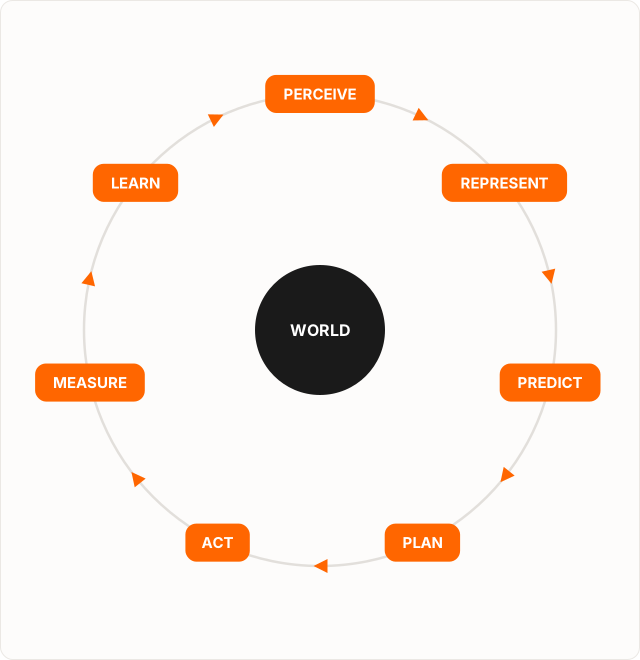
The deepest difference between a chatbot and a physically capable intelligent system may be the feedback loop.
A chatbot:
input → model → output.
A closed-loop agent:
observe → model → predict → plan → act → observe outcome → update → repeat.
The second architecture is much closer to an organism interacting with an environment.
And this changes the meaning of intelligence.
Intelligence is no longer merely producing correct representations.
It becomes the ability to maintain useful representations while reality changes.
The system has to remain grounded.
It has to notice when its model is wrong.
It has to experiment.
It has to learn.
It has to act.
That is a much more demanding definition of intelligence.
27The physical world becomes the training data
If an AI system can interact with the physical world, the world itself becomes an enormous source of experience.
Every interaction generates information.
A robot picks something up.
It learns how that object behaves.
It attempts a movement.
It learns about friction.
It enters a room.
It learns spatial relationships.
It performs a manufacturing process.
It observes a defect.
It changes the process.
It repeats.
This is fundamentally different from a static dataset.
The system is generating experience through action.
That creates a potentially powerful loop:
ACTION
→ EXPERIENCE
→ DATA
→ MODEL UPDATE
→ BETTER ACTION
→ MORE EXPERIENCE.
This is one reason embodied intelligence could become so important.
The environment is no longer merely something the system operates in.
The environment becomes part of the learning process.
28The possibility of machine-speed science
One of the most interesting applications is scientific discovery.
A sufficiently capable system could potentially:
read scientific literature,
form hypotheses,
design experiments,
simulate outcomes,
operate laboratory equipment,
analyze results,
update hypotheses,
and run another experiment.
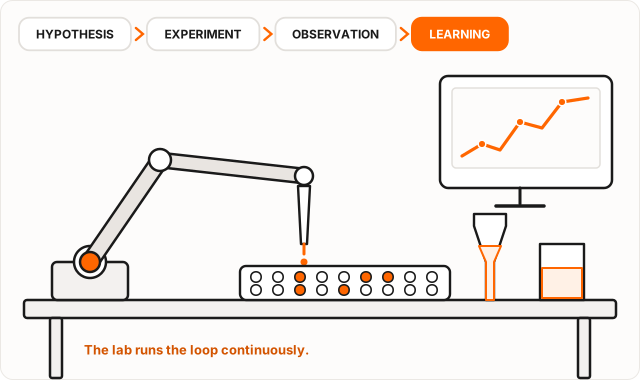
That would turn scientific research into a partially automated closed loop.
The value would not come from an AI “knowing all science.”
It would come from compressing the cycle between:
hypothesis
→ experiment
→ observation
→ learning
→ new hypothesis.
Humans already do this.
Machines could potentially run the cycle continuously and at much greater operational scale.
That is a more concrete vision of machine-accelerated intelligence than simply saying “AI will be smarter than humans.”
29Energy may become the physical bottleneck
There is a danger in talking about infinite productivity without talking about energy.
Intelligent machines require energy.
Compute requires energy.
Factories require energy.
Robots require energy.
Transportation requires energy.
If intelligent automation scales dramatically, energy infrastructure becomes increasingly important.
This creates another possible feedback loop:
better AI
→ better engineering
→ better energy systems
→ more available energy
→ more compute and manufacturing
→ better AI.
This is speculative as a future macroeconomic loop, but the underlying engineering relationship is straightforward.
AI cannot escape physics.
The intelligence layer still runs on physical infrastructure.
30The semiconductor and compute layer
The same applies to computation.
AI systems are physical.
They run on chips.
Those chips require:
- materials
- manufacturing
- energy
- cooling
- memory
- networking
- and capital.
If intelligence becomes a general-purpose production input, compute becomes an industrial resource.
That means semiconductor manufacturing and data-center infrastructure are not peripheral to the AI story.
They are part of it.
The AI future therefore depends partly on a physical industrial base that can produce increasingly capable computational machinery.
Again:
software does not float above reality.
Software is embedded in hardware.
Intelligence is embedded in infrastructure.
31Why this could change production
Imagine a manufacturing environment in which intelligence is available continuously.
Machines can inspect.
Robots can manipulate.
Software can schedule.
Agents can coordinate.
Models can predict maintenance.
World models can simulate changes.
Humans can supervise higher-level objectives.
The result is not necessarily a factory with no humans.
It may instead be a factory in which human labor is increasingly amplified by machine intelligence.
That distinction matters.
The goal should not be to imagine humans disappearing.
The more useful question is:
What becomes possible when human creativity, judgment, and direction are amplified by systems capable of operating continuously at machine speed?
A single engineer could potentially supervise systems doing work that previously required entire teams.
A small company could operate with capabilities that once required large organizations.
A scientist could run many more experiments.
A manufacturer could iterate designs faster.
A farmer could monitor larger areas more precisely.
A city could optimize infrastructure continuously.
The leverage comes from amplification.
32Intelligence as a general-purpose technology
Some technologies are valuable because they perform one function.
Others become foundational because they can be applied across many domains.
Electricity became foundational because it could power many different machines.
Computing became foundational because it could perform many different forms of information processing.
The internet became foundational because it connected information and people at global scale.
General-purpose AI could become foundational because it provides a layer of adaptable cognition.
But the analogy only becomes powerful when AI is connected to the rest of the technological stack.
An intelligence that cannot act remains constrained.
An intelligence that can act through software has much greater leverage.
An intelligence that can act through physical machines has another order of possibilities.
An intelligence connected to global infrastructure becomes something closer to a general-purpose technological substrate.
33The future may be built from intelligent elements
This brings us back to the original claim.
AGI may not arrive as one dramatic moment when a single model suddenly becomes “general.”
It may emerge through accumulation.
Better perception.
Better memory.
Better world models.
Better planning.
Better reasoning.
Better tool use.
Better simulation.
Better robotics.
Better continual learning.
Better coordination.
Better safety.
Better infrastructure.
Better integration.
Each component increases the capability of the system.
Eventually, the distinction between “model” and “system” becomes less useful.
The intelligence exists in the architecture.
That is why I think we should be building the elements now.
Not waiting for some final AGI model.
Build the perception systems.
Build the world models.
Build the memory systems.
Build the agent infrastructure.
Build the simulation environments.
Build the robotic interfaces.
Build the safety layers.
Build the energy systems.
Build the manufacturing capacity.
Build the financial infrastructure.
Build the networks that distribute these capabilities.
If AGI is ultimately an architectural phenomenon, these are not side projects.
They are pieces of the architecture.
34The internet made information abundant. What makes capability abundant?
The internet changed the economics of information.
A document could be copied nearly for free.
A lecture could reach millions.
A software tool could be distributed globally.
A person in one country could learn from another country instantly.
AI is beginning to change the economics of cognitive work.
A model can be replicated.
An agent can operate continuously.
A software capability can be distributed globally.
But physical capability is still constrained by atoms.
A robot must be manufactured.
A factory must exist.
Energy must be generated.
Goods must move.
Materials must be extracted.
Infrastructure must be maintained.
This creates a profound asymmetry:
Information can approach zero marginal distribution cost.
Physical capability cannot.
The future of abundance may therefore depend on closing the gap between cheap digital intelligence and expensive physical execution.
That is where robotics, automation, manufacturing, energy, logistics, and infrastructure become central to the AGI conversation.
35The human role does not disappear
There is a tendency to describe advanced AI as a replacement for human capability.
A more useful framing is amplification.
Humans provide goals.
Humans define values.
Humans choose what is worth building.
Humans create institutions.
Humans decide what outcomes matter.
Machines can increasingly assist with the work required to achieve those outcomes.
That distinction becomes particularly important as systems become more capable.
The question should not simply be:
“What jobs can AI replace?”
It should also be:
“What can humanity accomplish if cognitive and physical capability become dramatically cheaper and more scalable?”
That question is much larger.
36Designing the future instead of merely predicting it
Technological progress is often discussed as though the future is something that happens to us.
It isn’t.
People build it.
Researchers choose what to investigate.
Engineers choose what to manufacture.
Founders choose what to deploy.
Investors choose what to fund.
Governments choose what infrastructure to support.
Communities choose what technologies to adopt.
The future is therefore not simply predicted.
It is designed through millions of decisions.
If AGI and embodied intelligence become major technological layers, the people building the surrounding infrastructure will shape how those capabilities actually reach society.
That means the infrastructure problem is also a design problem.
How do we make intelligence accessible?
How do we connect it to useful tools?
How do we deploy it safely?
How do we make it affordable?
How do we distribute the benefits?
How do we build systems that amplify people instead of merely centralizing capability?
These are not secondary questions.
They are part of the technology itself.
37A different way to think about the next few decades
The popular image of the AI future is often one giant machine.
One AGI.
One superintelligence.
One model that knows everything.
There is another possibility.
A world filled with intelligent systems.
Small models.
Large models.
Specialized agents.
General agents.
Robots.
Sensors.
Factories.
Scientific systems.
Software infrastructure.
Energy systems.
Financial systems.
Human organizations.
All connected.
All exchanging information.
All capable of learning.
All operating at different levels of abstraction.
The result would not be one artificial brain.
It would be an intelligent technological ecosystem.
That ecosystem could potentially become more capable than any single system because capability would exist at multiple layers.
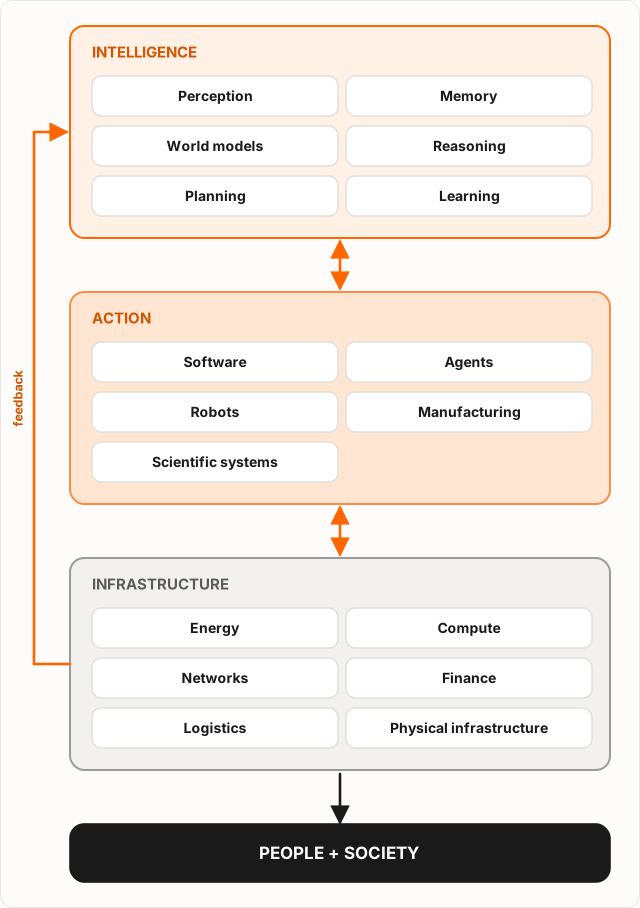
38The architecture of a possible intelligent world
At the individual-system level:
PERCEPTION
→ MEMORY
→ WORLD MODEL
→ REASONING
→ PLANNING
→ ACTION
→ FEEDBACK
→ LEARNING.
At the infrastructure level:
ENERGY
→ COMPUTE
→ MODELS
→ AGENTS
→ ROBOTS
→ APPLICATIONS
→ PEOPLE.
At the civilization level:
INTELLIGENCE
→ AUTOMATION
→ PRODUCTION
→ DISTRIBUTION
→ ACCESS
→ ABUNDANCE.
These layers interact.
Better intelligence improves infrastructure.
Better infrastructure enables better intelligence.
Better robots generate better physical data.
Better data improves models.
Better models improve robots.
Better energy systems increase available compute.
Better compute enables more capable models.
The entire system can form a positive feedback loop.
That is the deeper possibility.
Not merely AGI.
An increasingly intelligent technological civilization.
39What i think is worth building now
If this thesis is even directionally correct, there are several categories of technology worth building today.
Systems that give AI persistent memory.
Systems that give agents reliable access to tools.
World models that can represent environments and predict consequences.
Simulation environments that allow agents to learn safely.
Robotic systems capable of general manipulation.
Sensor systems that provide rich environmental information.
Infrastructure that allows models to operate cheaply.
Software that coordinates specialized intelligence.
Hardware that makes intelligence physically actionable.
Energy systems that support increasingly computational civilization.
Financial infrastructure that allows new technological capacity to be deployed globally.
And interfaces that allow ordinary people to actually access these capabilities.
The common thread is not “AI” as a category.
The common thread is:
making intelligence useful in the real world.
40The thesis
So I come back to the original statement:
AGI & Architectural Design.
Not because model scaling is irrelevant.
Not because the brain has already been reverse-engineered.
Not because embodiment is definitively required.
And not because we already know the architecture that will produce AGI.
We do not.
The thesis is simpler.
General intelligence appears to require more than isolated pattern generation.
It requires some combination of perception, representation, memory, prediction, reasoning, planning, action, feedback, learning, and adaptation.
The more capable those elements become, the more important their integration may become.
And the closer an intelligent system gets to operating in the real world, the more important world models, embodiment, simulation, infrastructure, safety, and physical execution become.
This means the path to AGI may not look like a straight line from:
model A
to
bigger model B
to
AGI.
It may look more like:
model
+
memory
+
world model
+
reasoning
+
planning
+
tools
+
simulation
+
embodiment
+
continual learning
+
feedback
+
infrastructure
→
a general intelligent system.
Build the architecture
The history of technology is the history of humans finding ways to extend themselves.
Machines extended our physical strength.
Writing extended our memory.
Computers extended our ability to calculate.
The internet extended our access to information.
Software extended our ability to automate processes.
AI is extending our cognitive capability.
The next step may be to connect that intelligence to the physical world.
To give it memory.
To give it world models.
To let it learn continuously.
To let it plan.
To let it act.
To let it experience consequences.
To let it operate through machines.
And then to build the infrastructure that allows those capabilities to reach the rest of humanity.
That is where the real opportunity lies.
AGI alone is not the destination.
A model that can reason is useful.
A system that can reason, perceive, learn, act, and adapt is more powerful.
A network of such systems connected to physical infrastructure is more powerful still.
And a world in which those capabilities are accessible to billions of people could change the economics of what humanity is capable of producing.
The future will not be built by intelligence alone.
It will be built by intelligence connected to infrastructure.
By software connected to hardware.
By models connected to environments.
By reasoning connected to action.
By invention connected to distribution.
And by human ambition connected to machines capable of helping us execute it.
The most important question may therefore not be:
“When will AGI arrive?”
It may be:
“What architecture are we building around intelligence today?”
Because if general intelligence is ultimately a system rather than a single model, then the future is already being assembled.
The pieces are here.
Perception.
Models.
Memory.
Agents.
World models.
Robotics.
Simulation.
Compute.
Energy.
Networks.
Infrastructure.
What remains is integration.
And that is the work worth doing.
The objective is not simply to build a machine that can think.
It is to build systems that can perceive reality, understand it, act within it, learn from it, and continuously improve their ability to change it.
Intelligence is one layer.
Embodiment is another.
Infrastructure connects them to the world.
Accessibility determines how widely their capabilities can be used.
Together, those layers could become one of the most consequential technological architectures humanity has ever built.
That is the direction worth narrowing the next few decades around.
Not merely predicting the future.
Building the systems that make a better one possible.
Sources and further reading
- Kunsthistorisches Museum: The Tower of Babel
- Wikimedia Commons: The Tower of Babel (Vienna)
- Stanford AI Index 2025: Research and Development
- Stanford AI Index 2025: Full report PDF
- Numenta: The Thousand Brains Theory of Intelligence
- Numenta: A Thousand Brains book
- Numenta: Thousand Brains scientific framework context
- Numenta: The Path to Machine Intelligence
- Numenta: 2024 Thousand Brains Project
- Numenta: 2025 Thousand Brains Project nonprofit
- Google DeepMind: Genie 3
- Google DeepMind: Genie 3 announcement
- Springer: World-model / physical-AI research reference
- Google DeepMind: Research blog
- Figure AI
- Boston Dynamics
- NVIDIA Robotics
- MIT CSAIL
- Stanford AI Lab
- Stanford AI Index